

Introduction
Internet of Things (IoT) development has led to technologies like Digital Twin, utilized across logistics, healthcare, automation, manufacturing, and asset management industries. A Digital Twin is a virtual representation of a physical object or process, simulating real-world performance to predict and analyze physical asset functionality, classified into various types with distinct uses.
Digital Twin technology, originating from NASA for aircraft performance simulation, significantly impacts manufacturing and other sectors. Equipment manufacturers utilize it for sustainable growth, often integrating it with artificial intelligence (AI) and machine learning (ML) for predictive modeling and accurate results. This technology benefits professionals aiming for careers in digital transformation, digital replicas, predictive data analysis, big data analytics, asset management, and R&D fields.
Digital Twins model physical systems to enhance performance through design solutions. A solid grasp of IoT concepts, including devices and data, is essential. Familiarity with Python, Azure, Java, SQL queries, and CAD drawing is beneficial.
Core Components and Technology Stack
A digital twin is composed of multiple essential parts that come together to form a comprehensive virtual model, including physical object, data collection, and digital model. Consequently, a physical object is represented as a real-world entity, sensors and IoT devices collect real-time data, and a digital model is represented as a virtual representation with simulation capabilities. The implementation of digital twins is also performed using various technologies, including IoT sensors, cloud computing, and AI/ML. Accordingly, IoT sensors gather real-time data from physical assets, cloud computing stores and processes large amounts of data, and AI/ML performs predictive analytics and decision-making.
Technologies and Characteristics
In other words, Digital Twin can integrate with various technologies, including AI, IoT, big data analytics, data management, cloud computing, cybersecurity, project management, software development, 3D representation models, and augmented reality (AR) systems.
Digital Twin technology models physical systems with accurate simulations and characteristics, such as:
- Digital Twins predict complex data sets mathematically.
- Digital Twins connect physical objects to counterparts.
- Digital Twins use sensors for real-time data and simulate reality.
- Digital Twins enable predictive analysis and modularity for data performance tracking.
- Digital Twins enable problem diagnosis and rapid data computation.
Benefits and Levels
Digital Twin technology provides numerous benefits for users, such as predictive maintenance and development, performance monitoring, process optimization, ensuring quality and integrity, protecting data privacy, precise models, enhancing operational and engineering efficiency, and enhancing the customer experience.
Digital Twins vary in levels according to complexity, scope, and industry applications. Here is an overview:
- Virtual Twin (first level) is a replica of physical assets.
- Connected Twin (second level) integrates data and asset performance.
- Predictive Twin (third level) identifies issues and forecasts outcomes.
- Prescriptive Twin (fourth level) combines advanced modeling techniques.
- Autonomous Twin (last level) learns from data and makes decisions quickly.
Subtypes, Modeling, and Use Cases
Digital Twins have various subtypes:
- Digital Twin Prototype (DTP) includes design and analysis tools for physical assets.
- Digital Twin Instance (DTI) connects to physical counterparts.
- Digital Twin Aggregate (DTA) aggregates DTI for insights on physical products.
Digital Twin models enhance decision-making and enable comprehensive data analysis. Let us explore them briefly, as follows:
- Data Driven Model optimizes scheduling techniques.
- Similarity Model uses records from similar machines’ history.
- Survivor Model utilizes data from failures.
- Degradation Model employs data from safety thresholds without failures.
Digital Twin consists of adaptive models that replicate physical systems, predict real-time performance, and support various use cases in the digital environment. Sensors on physical assets generate extensive data. Digital Twin technology varies in complexity based on the use cases, such as aerospace and defense area, streamlined and supply chain process, advanced diagnostics, renewable energy optimization, oil and gas area, sustainable operations, disaster management, cargo management, and agricultural industries. However, in a board range, it can be used in manufacturing (e.g., predictive maintenance, process optimization, and process optimization), smart cities for urban applications (e.g., traffic management, energy efficiency, and infrastructure planning), and healthcare for medical applications (e.g., patient monitoring, medical device management, and treatment planning).
Popular Tools and Main Pillars
Digital Twin offers various supportive tools, such as Ansys Twin Builder, Autodesk Tandem, Azure Digital Twins, Bentley Systems, AVEVA, ANSYS, and COMSOL Multiphysics. Furthermore, Digital Twin services optimize operations, achieving goals through accurate representations of assets, generating valuable performance and behavior insights. The main pillars of Digital Twin technology include data combination, connectivity, and processing. They enable software design patterns for physical objects, facilitating fast production, reduced maintenance, decreased downtime, and performance monitoring.
How Does the Digital Twin Work?
Digital Twin, a metaverse component, creates virtual models for physical objects or processes, enabling simulation across various enterprise applications in virtual reality (VR). The following block diagram shows an overview of the Digital Twin with a basic model.
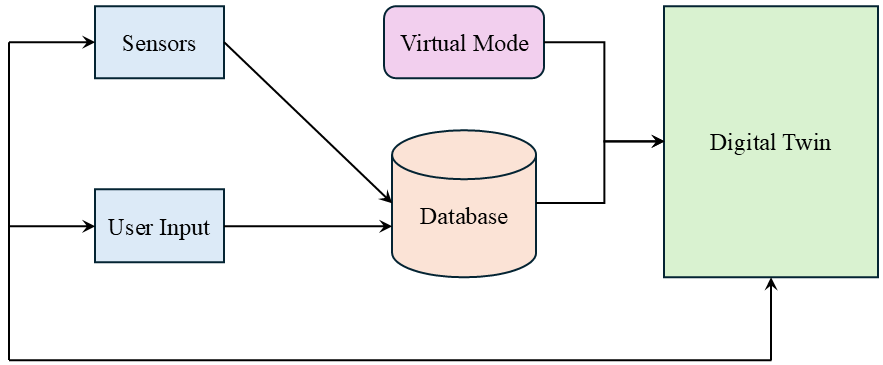
The main purposes of Digital Twins can be represented as below:
- Predict Performance: Digital Twin simulates and predicts the performance of physical products.
- Detect Errors: Digital Twin utilizes real-time sensor data to monitor operations and detect errors.
- Decision Making: Digital Twin aids decision-making by simulating real situations.
- Machine Learning Algorithms: Digital Twin employs machine learning algorithms to process large sensor data sets.
- Remote Monitoring: Digital Twin enables remote control and monitoring of hazardous industrial equipment.
- Preventive Maintenance: Digital Twin models equipment or processes for identifying preventive maintenance needs.
- Interoperability: Digital Twin technology is integrated with various enterprise applications like CAD, PLM, and ERP for interoperability.
Types of Digital Twins
Digital Twins are utilized in different representations, such as those below:
- Product Twin is the digital representation of a product.
- Data Twin links Google Maps with real-time data.
- System Twin connects physical and digital processes interactively.
- Infrastructure Twin represents physical infrastructures, such as highways and buildings.
Sample Project
Companies utilize specific software for digital twins, Azure Digital Twin, IBM Digital Twin Exchange, and AWS IoT TwinMaker, enabling complex monitoring and analysis capabilities. The following shows how to create a simple digital twin instance with Azure.
az login
az account set --subscription "<Azure-subscription-ID>"
az provider register --namespace 'Microsoft.DigitalTwins'
az extension add --upgrade --name azure-iot
az dt –help
az dt show --dt-name <Azure-Digital-Twins-instance-name>
First, it is needed to login and set CLI context for subscription session. Then, Azure Digital Twins namespace should be registered. IoT services are upgraded for interaction with Azure digital twins. The help command can be used to verify the digital twin commands. The required permissions need to be set up to use Azure Digital Twins instance. Azure digital twin instances can be configured, and existing models can be downloaded to create and develop new models accordingly.
Architecture
Digital Twin Technology enables efficient R&D management using the following simple architecture:
- IoT-Enabled Physical Asset (Level 1): First architecture level involves IoT-enabled assets such as sensors and software programs for data exchange via the Internet.
- Data Collection (Level 2): Collecting data, the second architecture level, gathers information from sensors, IoT devices, and historical records.
- Data Synchronization (Level 3): Data synchronization is the third process level, representing real-time entities at specific frequency.
- Data Process and Analytics (Level 4): The fourth architecture level involves data processing, analyzing, and simulating behaviors through Digital Twin and virtual models under various circumstances.
- User Interface (Level 5): Friendly User Interface is the final architecture level, interacting with users, collecting feedback, and providing real-world data for digital twins continuously.
Command Line Interface (CLI)
Digital Twins are created from model definitions. Executing simple commands in client applications is explained as follows. A digital twin can be created using the following command.
CreateDigitalTwin dtmi:example:Floor;1 floor0 FloorName string FirstOutput
CreateDigitalTwin dtmi:example:Floor;1 floor0 FloorName string First
Preparing..
Submitting..
Twin 'floor0 created successfully!
Any changes can be made to the digital twin using the command below.
UpdateDigitalTwin floor0 add /FloorName string SecondOutput
twin was updated successfully.The changes can also be verified using the following command, reflecting the updated name.
GetDigitalTwin floor0Twin Graph creates relationships between twins, representing their entire environment. The command below creates one more twin.
CreateDigitalTwin dtmi:example:Room;1 room0 RoomName string FirstRoomOutput
CreateDigitalTwin dtmi:example:Room;1 room0 RoomName string FirstRoom
Preparing..
Submitting..
Twin 'room0 created successfully!
Both twins can be combined using the following command, adding a “contains” relationship from floor twin corresponding to room twin.
CreateRelationship floor0 contains room0 relationship0Output
CreateRelationship floor0 contains room0 relationship
Submitting..
Relationship relationship0 of type contains created successfully from floor0 to room0
The relationships can be verified using the command below.
GetRelationships floor0The relationship between the two twins is shown below.

The following command lists out all the environment queries in Twin Graph, displaying each digital twin with its details.
QueryThe command below lists out all the digital twins instances.
Select * from digitaltwinsFurthermore, the following command cleans up resources in digital twins.
az group delete --name <'resource-group'>Digital Twin Definition Language (DTDL)
Microsoft has developed the Digital Twin Definition Language (DTDL) for the creation of physical assets and systems effectively. This language uses a variant of JSON, linking with JSON objects. The state and behavioral characteristics for physical entities are described by metamodel classes, serving as a digital template that outlines the structure and rules in which how elements are associated with a physical entity. In addition, the property class represents those elements that do not change the frequency, as exemplified by the simple property of a vehicle shown below.
"@type": "Property",
"name": "vehicleName",
"schema": "string"
In this example, @type defines the type of information, name is a user-defined element, and schema is the data type of the element. The telemetry class can describe the data emitted by a physical entity. For example, the telemetry elements of a vehicle can be represented as follows.
"@type": "Telemetry",
"name": "airQuality",
"schema":"string"
The command class can describe a function or operation performed by a physical entity. A simple command model shown below.
"@type": "Command",
"name": "restart",
"request":{
   "name":"restartTime",
   "schema": "dateTime"
}
"response":{
   "name":"scheduledTime",
   "schema": "dateTime"
}
In this example, the request indicates the input to the command and the response indicates the output of the command. Moreover, the relationship metamodel can describe how physical entities are connected to each other, as exemplified below.
"@type": "Relationship",
"name": "floor",
"target":  "dtmi:com:example:Floor;1"
An interface can represent the contents of any digital twin, which is reusable and serves as a schema for existing components in another interface. Complex schemas are defined inside an interface to be reused across commands, properties, and telemetry.
A collection of data with each element described in the same schema is referred to as an array. Additionally, the schema can be classified as primitive or complex. A simple example is provided as follows.
"@type": "Telemetry",
"name": "vehicles",
"schema":{
   "@type":"Array",
   "elementSchema": "string"
}
In conclusion, a digital twin is a virtual representation of a physical entity. These virtual models are utilized to digitally reflect performance and provide solutions to enhance their physical counterparts.
Implementation
The implementation of digital twin solutions can be done in three phases: planning, development, and deployment. The planning phase is carried out by defining objectives, evaluating the infrastructure, and selecting the technology. The development phase is carried out through data collection, model building, and integration. Furthermore, the deployment phase is carried out through testing, training, and monitoring.
References
- Tutorials Point. Digital Twin Tutorial. Retrieved March 10, 2026, from https://www.tutorialspoint.com/.
- AGB Spatial. Digital Twins Basics, A Comprehensive Guide to Digital Twin Technology and Applications. Retrieved March 25, 2026, from https://www.agb-spatial.com/.

Leave a Reply